
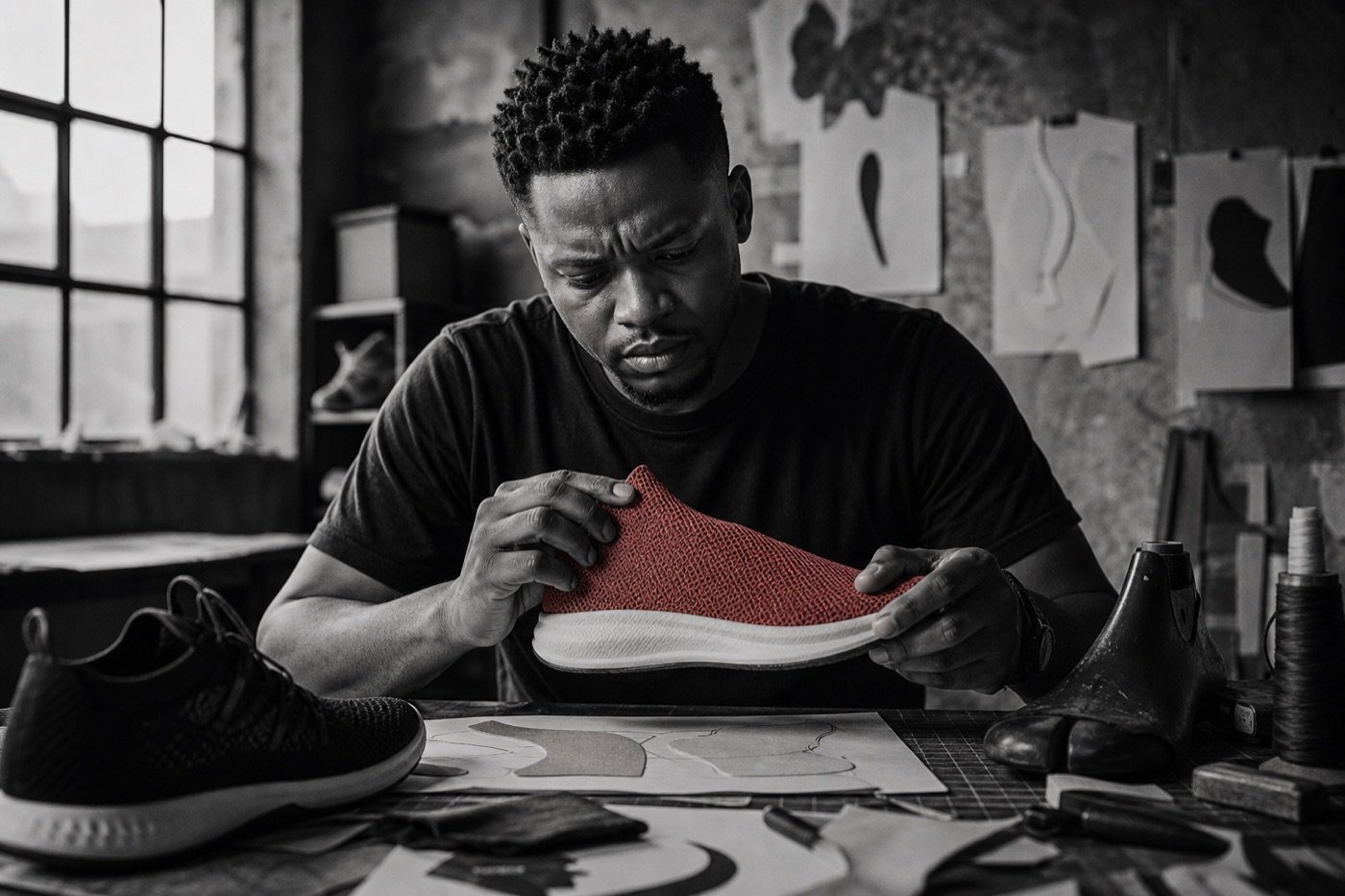
In September 2021, in the middle of the worst trading conditions the South African retail sector had seen in living memory, Theo Baloyi opened his thirtieth Bathu store.
Twenty-four of those stores had opened since the pandemic began.
Think about what that required. Retailers around him were collapsing. Edcon, one of the largest clothing groups in the country, had gone under. Landlords were desperate, foot traffic had evaporated, and every rational instinct in the market said stop, wait, preserve cash, see what happens. And a young sneaker brand, less than five years old, run by a former accountant, went out and signed lease after lease after lease.
Here is the part that matters. If Baloyi had taken outside investment, that expansion would almost certainly never have happened. Somebody on a board or a cap table would have looked at the world in 2020 and said, sensibly and cautiously, not now. And they would have been entitled to say it, because they would have owned a piece of the business.
He had nobody to ask.
That is the real Bathu story, and it is not the one that usually gets told.
The version everyone repeats
The story you will have heard goes something like this. A young man from a township is rejected by a shoe factory thirteen times because he insists on building a sneaker made entirely of mesh, and eventually he flies to the factory in person, and they look into his eyes and see how badly he wants it, and they give him a chance.
It is a good story, and most of it is true. But it is worth being careful with it, because Baloyi himself has told it as sixteen rejections rather than thirteen, and the number has hardened into brand mythology in the retelling. The exact figure is not the point anyway. The point is what he was actually being rejected for, and why he would not let it go.
Baloyi was born in Ga-Rankuwa in 1989 and grew up in a village called Phake near Hammanskraal. He moved to Alexandra as a student, to live with an uncle while he studied accounting at Unisa, and he sold perfumes door to door to get by. His father, Solly, sold his own car during the 2008 financial crisis to keep his son’s university fees paid. He died in 2014, before any of this happened.
Baloyi qualified as an accountant, joined PwC through the graduate programme, and was posted to the Middle East as a senior associate. And it was there, on an eight-hour layover in Dubai on the way to a job in Saudi Arabia, that the whole thing started.
He was a sneakerhead. He wandered into a duty-free store that had a constant stream of customers, and got talking to a Frenchman selling an unapologetically French brand, telling a French story to people who wanted to hear it. Baloyi went home and thought about his own sneaker cupboard, and realised there was not a single African brand in it. Not one. Africans consume enormous quantities of sneakers, and none of the brands they wear belong to them.
As he put it later, when you buy that much of something, why would you not want to own part of it.
The accountant ran an experiment
Now the part that gets skipped, and the part that actually explains everything that followed.
Baloyi registered Bathu in 2015. He did not quit PwC until 2017. He kept his job through the entire research and development phase, roughly eighteen months of it, through twenty-one samples, through all those factory rejections, and through the launch of the first Mesh Edition in 2016. He has been explicit about why. The job forced focus and consistency on him. It also meant that when the business finally needed him, it needed him rather than his salary.
And he funded the whole thing himself, out of savings from those Middle East years.
He has described this in the language of his own profession, and it is revealing. He wanted to know whether it was possible to start a business with no funding, bootstrap it, and grow it from there, because he had never seen a balance sheet like that in his accounting background. It began, in his words, as a passion project to see if he could really do that.
That is not a founder chasing a valuation. That is an accountant running an experiment on himself.
The first order was one hundred pairs, funded from his savings, against a factory minimum order quantity of one thousand two hundred. He talked the factory into it by promising the volume would come later. When the sneaker launched in 2016, the website fell over about four hours after the announcement. Reorders climbed from four hundred to a thousand to four thousand within a month. He sold from the boot of his car and from a room in Alexandra, and he has said, plainly, that he did everything himself in those early days. He set up the supply chain, packed the boxes, arranged the couriers, ran the e-commerce, did the PR and the marketing, and acted as his own receptionist and his own night security for the stock.
What he was really selling
The product decision was smart, and worth understanding, because it was not a fashion whim.
Around 2015 and 2016 there was a trend among sneaker collectors of wearing bright socks pulled up above the ankle, deliberately visible. Baloyi’s answer was a shoe with a mesh upper, so that the sock was not just visible at the ankle but through the entire shoe. He calls it the breathing sneaker. That is why he would not compromise with the factories. Mesh was normally a component, not the whole upper, and he was asking them to build something they did not want to build, because the mesh was the entire idea.
But the deeper product was the story, and this is where Bathu separates itself from being a shoe company.
The name is township slang for shoe, and Baloyi makes a specific point about it. It does not matter which language a South African speaks, he says, everyone knows what bathu means. It unites people, and that is what the business is about. The tagline is Walk Your Journey. Later ranges built meaning directly into the product: a range named for his own clan, another referencing Meadowlands and Sophiatown, and the 10/43 range named after 43 Tenth Avenue in Alexandra, the address where he made his first sale, with the Alexandra street map printed on the heel.
He was not competing with Nike on cushioning. He was offering something Nike structurally cannot offer a young South African, which is a brand that is theirs. That was the only opening available to him, and he took it.
Owning the route to the customer
Then he made the decision that a lot of small brands get wrong.
The obvious move for a young footwear label is wholesale. Get into the big retailers, let them carry the stock and the stores and the risk, and take the volume. Baloyi went the other way. He sold through his own website and, from 2018, through his own physical stores. Bathu products are essentially not available anywhere except Bathu.
That is expensive and slow, and it is also the whole game. It meant he kept the full margin instead of handing a slice to a retailer. It meant he owned the customer relationship and the data rather than renting it. It meant he could inspect the product himself. And it meant that when a decision needed to be made about where the brand appeared and what it stood for, he made it, rather than a category buyer in a head office who had never been to Alexandra.
Combine that with the funding decision and you get the whole philosophy. Baloyi did not just want to build a company. He wanted to keep every meaningful decision inside his own hands.
Funding is not just money. It is a say. Every rand you take hands someone a vote on a decision you have not made yet.
Which brings us back to 2020.
The pandemic was the payoff
When COVID-19 hit, the market did what markets do in a crisis. It froze. Retailers shut stores, cut headcount, and hoarded cash. Landlords, suddenly staring at empty malls and no tenants, became very willing to negotiate.
Baloyi looked at that and saw the cheapest retail space he would ever be offered in his life.
So he expanded into the teeth of it, funding the whole thing from cash flow, without outside funding and, by his own account, without even leaning on the bank overdraft. Twenty-four stores during the pandemic. Thirtieth store in September 2021, at Mall of the North in Polokwane. Revenue up around eighty percent year on year. His workforce went from forty-nine to eighty-four in 2020 alone.
Now, the point is not that expanding into a pandemic was clever in some abstract way. Plenty of businesses that did it went bust. The point is that Baloyi was structurally able to make the call at all. There was no investment committee. There was no board with a mandate to protect capital. There was no shareholder with a legitimate interest in caution and a legal right to be heard.
The years of refusing outside money did not just save him equity. They bought him the freedom to act while everyone else was asking permission.
The part that does not fit the story
Here is where an honest account has to slow down.
Bathu is built on a promise about place. Born in the township. An African brand for African people. It is on the heel of the shoes. And yet the shoes themselves are not made in South Africa. They are manufactured offshore, in the East, and Baloyi has been candid about the reason. He has said that manufacturing a new shoe in South Africa takes roughly eight months, where in the East it takes about four weeks.
Early coverage in 2019 quoted him describing a Durban factory that made the sneakers, and the marketing at the time certainly implied local production. Current reporting tells a different story. By 2025, Bathu was described as actively pursuing the establishment of a manufacturing facility in South Africa, working with Chinese partners through the BRICS relationship, with the aim of transferring skills and training local people. That is a stated ambition, not an achieved fact, and the phrasing quietly concedes that production today is not local.
The criticism has been public. In January 2022 the media personality Nota Baloyi, no relation, attacked both Bathu and its rival Drip for manufacturing in Asia rather than creating jobs at home, arguing that black-owned brands should not be dumping imported product into South African ports while local workers are asked to compete with Asian labour. It trended. Cassper Nyovest publicly defended the brands, and plenty of people pointed out, fairly, that Nike and Adidas manufacture in Asia too.
Both things are true at once. Bathu employs around five hundred people, close to ninety percent of them in the value chain, across close to forty stores as of early 2025, one of them in Namibia, selling somewhere around two hundred and fifty thousand pairs a year. That is real employment, and it is real ownership of a route to market that used to belong entirely to foreign brands. But the factory, the deepest part of the value chain, and the part that would create the most jobs, is still somewhere else.
And there are the ordinary operational scars too. Bathu carries a poor rating on Hellopeter, with a steady trickle of complaints about delivery delays and slow refunds on online orders. The customer experience has not always kept pace with the story.
Where I land on this
The lesson I am taking from Bathu is not the rejections, and it is not the pandemic expansion on its own. It is the thing underneath both, which is that Theo Baloyi thought very carefully about who was allowed to have an opinion on his business.
He kept his job so the company would never be a hostage to his salary. He refused outside money so that no one would ever hold a vote on his timing. He refused wholesale so that no retailer would ever own his customer or his margin. Every one of those decisions cost him speed and cost him comfort, and every one of them bought him the same thing, which was the right to decide alone.
Then a global crisis arrived, and that right turned out to be worth more than all the capital he had turned down.
I think about this a lot in my own work, because the pressure runs the other way. Take the investment. Take the big retainer that becomes half your revenue. Take the partner. Each one feels like acceleration, and each one quietly hands somebody a seat at a table where your future decisions get made. Baloyi’s discipline was to notice that trade before he made it, not after.
And then the honest caveat, which is that control has an edge. He owns the brand, the stores, the customer and the story, but he does not own the factory, and the very promise that made the brand work, that it belongs to this place, is the promise the supply chain does not yet keep. He knows it. He is trying to fix it. The gap is real and it is fair to name it.
A sneaker cupboard with no African brand in it started all of this. He set out to put one there, and he did it by refusing, over and over, to let anyone else hold the pen.
That is the part that does not fit on a heel.
Sources
- How We Made It In Africa, “An African sneaker brand: Founder of Bathu explains how he built his business” (October 2020). The Dubai airport encounter, the minimum-order-quantity negotiation, the reorder progression, manufacturing lead times in South Africa versus the East, and the e-commerce origins. https://www.howwemadeitinafrica.com/an-african-sneaker-brand-founder-of-bathu-explains-how-he-built-his-business/74205/
- News24 / Fin24, “Bathu opens 30th store without any funding” (October 2021). The 24 stores opened during the pandemic, the 30th store at Mall of the North, the roughly 80 percent revenue growth, and Baloyi’s own account of bootstrapping as an accountant’s experiment. https://www.news24.com/fin24
- Mail & Guardian, Q&A with Theo Baloyi (December 2021). Why he kept the PwC job until 2017, the 2015 registration and 2016 launch, and the rationale for physical stores. https://mg.co.za
- Drum / SNL24, “Hitting his stride” (28 June 2019). The earliest detailed profile: the R18.5 million turnover across the first three years, the sock trend behind the mesh design, the meaning of the name, and his own “16 rejections” and Durban factory account. https://www.snl24.com/drum/Inspiration/hitting-his-stride-20190628
- BusinessTech, “The man who had over a dozen rejections and then launched one of Africa’s most successful shoe brands” (2025). The rejection account, and the most recent scale figures: close to 40 stores including Namibia, around 500 employees, and the plan to establish local manufacturing with Chinese partners through BRICS. https://businesstech.co.za/news/business/814571/the-man-who-had-over-a-dozen-rejections-and-then-launched-one-of-africas-most-successful-shoe-brands/
- Forbes Africa, “Small Giants: Walking Ahead And The Theories Of Theo” (12 July 2024). The 250,000 pairs a year figure, 32 stores, 300-plus employees, and the “why not own it” philosophy. https://www.forbesafrica.com/cover-story/2024/07/12/small-giants-walking-ahead-and-the-theories-of-theo
- Wikipedia, “Theo Baloyi.” Biographical scaffolding, the PwC posting, awards including Forbes Africa 30 Under 30 (2019) and GQ Business Leader of the Year (2021), and the Bathu for Batho pledge. https://en.wikipedia.org/wiki/Theo_Baloyi
- Public commentary, January 2022. Nota Baloyi’s criticism of Bathu and Drip over offshore manufacturing, and Cassper Nyovest’s public defence of the brands, widely reported across South African media.
Editorial notes
- The rejection count is given as 13 in most coverage and on Bathu’s own site, but Baloyi told Drum in 2019 that it was 16. The piece flags this rather than asserting either number.
- Store counts and headcount have changed rapidly. Figures used here are dated: roughly 40 stores and 500 employees as of early 2025, 32 stores and 300-plus employees as of mid-2024, 30 stores as of September 2021.
- Baloyi was born in Ga-Rankuwa and raised near Hammanskraal. He moved to Alexandra as a student. Accounts describing him as born and raised in Alexandra are inaccurate.
- Turnover figures beyond the R18.5 million first-three-years number are founder-reported growth percentages, not audited results, and are described as such.