
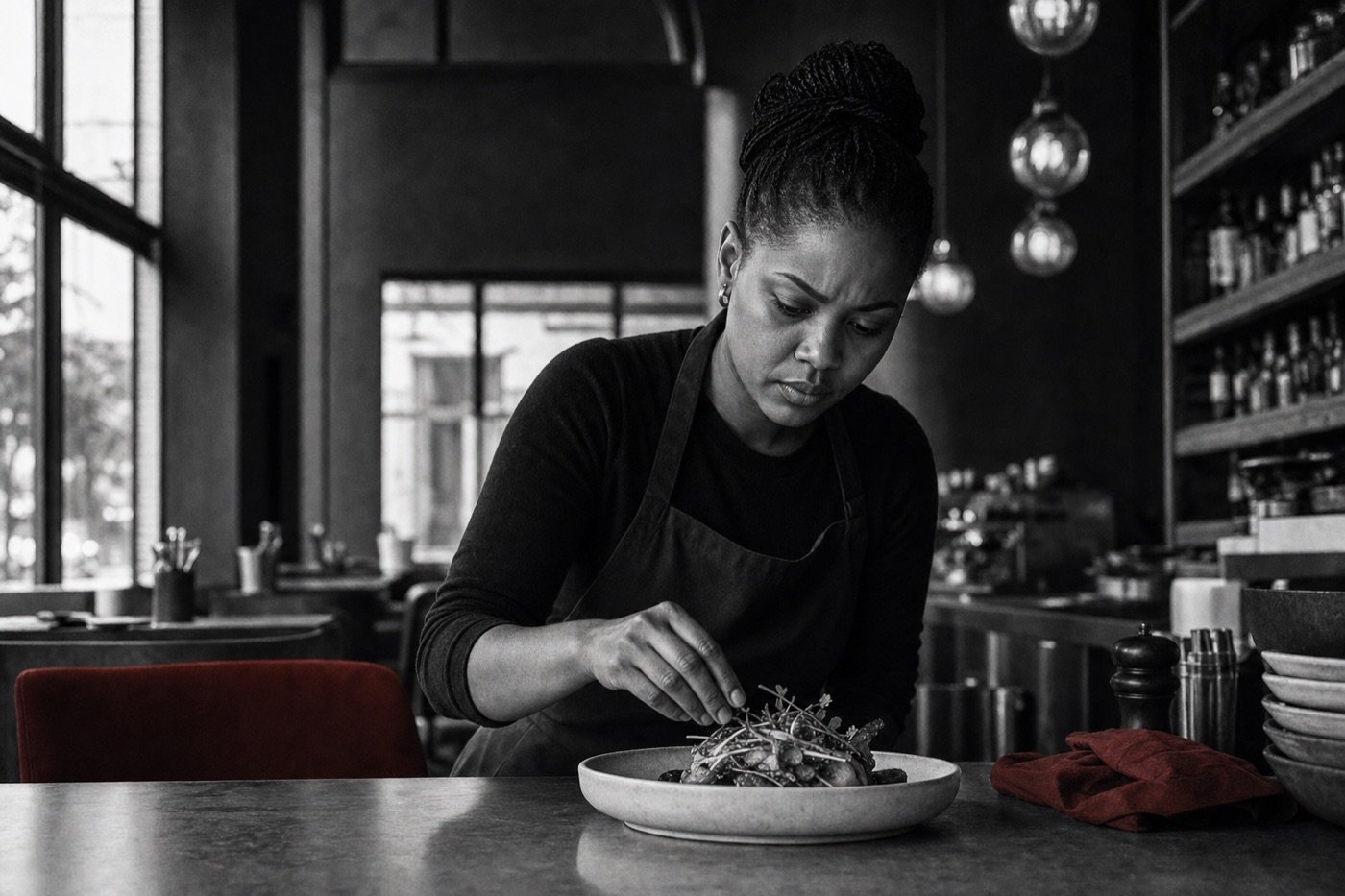

Earlier this year, Natasha Sideris thought she might lose the business that carries her name.
The Iran conflict had erupted across the Middle East, and it erupted at the worst possible moment, just as she stood ready to sign a major new expansion in the United Arab Emirates. She was in Cape Town recovering from knee surgery when the scale of it landed. Sales at some of her stores fell by 30 to 40 percent at the height of the conflict. The question in her head, by her own account, was blunt and total. Are we going to potentially lose our business.
If that fear sounds familiar, it is because she had felt it before. She felt it during COVID-19, when the entire restaurant industry came within a breath of collapse. And she felt it right at the very beginning, in 2005, when the money that opened the first Tashas came not from a bank, but from a loan shark.
This is the part worth understanding about Natasha Sideris. The dramatic moments are not the exception in her story. They are the texture of it. What is interesting is not that she keeps facing the prospect of losing everything. It is what she keeps reaching for to survive it.
She did not want to call it Tashas
Sideris is third-generation hospitality. Her father, Harry Sideris, was a prolific Johannesburg restaurateur, and she grew up at his side, moving between restaurant floors, learning the trade from the time she was a child. Greek family, food at the centre of everything. One of her earliest memories is of a treehouse her grandfather built her in Highlands North, where she would coax relatives up a ladder to eat meals made from her grandmother’s recipes. She was hosting before she could have told you that was what it was.
She did everything she could to avoid the business. Her father had warned her off it for years, the long hours, the unforgiving schedule, the fact that the only day the family got him was a Monday, when South African restaurants closed. So she went to study psychology at the University of the Witwatersrand, working part-time in her father’s Fishmonger restaurant to pay her way, telling herself she would do something else.
She did not do something else. She helped run the Fishmonger, then moved to its head office and opened eight or ten restaurants for the group as training and operations manager. In 2001 she bought a Nino’s franchise in Bedfordview, a tired coffee shop selling muffins and toasted sandwiches, and turned it around by doing the one thing nobody else was doing, which was selling real food to people who were clearly there to eat. Years in the lower ranks, learning the business from the till upward. That detail matters later.
Then a landlord who admired her work offered her a site, on one condition. She had to build her own brand. He kept pushing one name. Call it Tashas. She resisted, because naming a restaurant after yourself is not a branding decision, it is a personal exposure. In her words, the responsibility around something being named after you is huge. She joked that if it failed she would simply change her name. Eventually she agreed.
The first Tashas opened in Atholl Square, in the Sandton area of Johannesburg, in 2005. No bank would fund it. So she went to a loan shark. She has never dressed this up. As she told Alec Hogg, the business books tell you not to overcapitalise, not to encumber yourself, and definitely not to go to a loan shark, and she did all three. She ended up with less money than she needed and more debt than she was prepared for, and then she worked fourteen-hour days, seven days a week, for four or five months, checking every plate and every drink herself, to pay it back.
The romantic plan had been a small cafe she could run while studying further. Instead it was packed from day one.
What she actually sold was hospitality
Here is the distinction that makes Tashas more than a nice story about a determined woman.
Sideris did not invent the upmarket cafe. Beautiful rooms and good food existed. What she did was treat hospitality itself as the product, and refuse to compromise it for the sake of growth. Fresh food made to order. Rooms designed to feel like the elegant cafes of Paris, New York and London. Service that was actually warm. And crucially, from the moment she opened the second store, she threw out the one thing that makes scaling easy.
She threw out the cookie-cutter.
Most restaurant groups grow by stamping out identical copies. It is cheaper, faster and far simpler to manage. Sideris decided that every Tashas would be different, each with its own interior and its own signature menu sitting alongside the core one, tuned to its location and its customers. A Parisian feel at Le Parc in Hyde Park. The tapas bars of Spain in one, a New York deli in another, the spice of the Levant in a third.
She now calls this “boutique at scale,” and it is a genuinely hard operating discipline, because it works directly against the economics of growth. Every new venue is a fresh design problem rather than a template to copy. It costs more, it takes longer, and it does not let you switch your brain off. But it is also the moat. It is very difficult for a larger, faster competitor to copy a group whose entire promise is that no two locations are the same. She chose the harder model on purpose, because the harder model was the defensible one.
Most groups scale by becoming more the same. Tashas scaled by staying different on purpose. The difficulty was the point.
The partner she took, and the one she let go
By 2008, with just two restaurants, Sideris did something that looks counterintuitive for someone so protective of her brand. She sold a majority stake, 51 percent, to the JSE-listed Famous Brands, the group behind Steers, Wimpy and Mugg & Bean.
The interesting part is why. It was not about money. By her own account there was very little funding actually put into the business. What she needed was structure. She did not know what a balance sheet was. She did not know how to read an income statement or write a business plan. Everything she had built, she had built on gut and operational instinct. Famous Brands brought corporate governance, admin systems and procurement, the unglamorous back end that a creative founder running on instinct simply did not have.
That is a clear-eyed piece of judgement, and most founders get it wrong in one of two directions. They either refuse all outside involvement and stay forever sub-scale, or they take a partner for the money and hand over the soul of the thing along with it. Sideris took a partner specifically for the capability she lacked, while keeping creative control of the part that mattered.
And then, just as importantly, she knew when the partnership was finished. In 2020, Famous Brands sold the 51 percent back to the Sideris family. Her reasoning was honest. The partnership had taught her an enormous amount about running a real company, but the two businesses had become too different for it to keep adding value. A steakhouse franchise model and a boutique hospitality group were pulling in different directions. So she bought her independence back. As she put it, she no longer had to report to anyone, and the effort she and her brother had poured in was now fairly theirs, rather than shared with a partner who had given what it had to give.
Take the structure when you need it. Return it when you have outgrown it. Very few founders are disciplined enough to do both.
People are not a cost line. They are the business.
The thread that ties the whole story together, from the loan shark to the war, is the thing most operators treat as soft, and Sideris treats as the actual asset.
When she took Tashas to Dubai in 2014, with her brother Savva, the setup ran to around R30 million, and the genuinely expensive part was flying thirty South African staff over to seed the culture. She insisted that seventy percent of the team at that first Dubai store be South African, because she was not exporting a menu, she was exporting a way of treating people. It was a frightening bet. Speaking on Stephen Grootes’s The Money Show, she remembered the terror of those first days. On day three, she said, they hardly had any customers. On day four, they got totally slammed. The group now runs around 45 outlets across five countries, South Africa, the UAE, Bahrain, Saudi Arabia and the United Kingdom, including a single London site at Battersea Power Station that opened in late 2023.
But the clearest proof that the people-first instinct is a business strategy and not a sentiment came in the crises.
During COVID-19 the group cut salaries temporarily, across the board, specifically to preserve jobs rather than shed them. When the 2026 conflict hit, she reached for the same lever. Her stores in Abu Dhabi were untouched by the war, and in fact were trading up around 15 percent, while others in the region were down by a third or more. So the profitable stores effectively carried the wounded ones. Staff whose own branch was thriving saw their salaries cut to protect colleagues whose branch was under fire, and they asked her, reasonably, why. Her answer was that the group is one family, and they should imagine how they would want to be treated if the roles were reversed. By her account, that one decision saved a lot of jobs, and the team got behind it.
That is culture functioning as a balance sheet item. A group of people who genuinely believe they are one family will absorb a shock that would shatter a group of individuals optimising for themselves. Sideris built that belief over twenty years, one fourteen-hour day at a time, and when the war came it did exactly the job it was quietly built to do. Across the region, aggregate sales were down only around 11 percent, and she came out the other side still expanding, with two new UAE stores opened since the worst of it and sites being scouted in Greece.
Where I land on this
There is a line Sideris keeps returning to that I cannot stop thinking about. She worries that a lot of people today want to go from zero to hero very quickly, and that what built her, the grit, the self-sacrifice, the years spent in the lower ranks, is exactly what is missing in that hurry.
I think she is right, and I think the reason is structural, not generational. When you skip the years at the till, you do not just miss the dues. You miss the thing those years actually teach you, which is how the business really works at the level of a single plate, a single shift, a single unhappy customer. Sideris can sign off on every dish and every interior across forty-five venues in five countries precisely because she once opened eight restaurants for someone else and checked every plate in her own first store herself. The authority is earned at the counter, not in the boardroom.
The other thing I am taking from this is uncomfortable for anyone who runs lean and treats payroll as the first thing to cut when trouble hits. Sideris does the opposite. In her worst moments she protects her people first, and she has now twice watched that decision pay her back in loyalty when she needed it most. In a service business, the staff are not delivering the product. They are the product. Cut them carelessly and you have nothing left to sell.
A loan shark funded the first Tashas. A war nearly took the whole thing away two decades later. And in both moments, the same instinct carried her through, the refusal to treat the people around her, staff or guests, as a line item rather than the entire point.
She put her own name on the door because the landlord insisted, and she nearly changed it out of fear. Twenty years on, it is above forty-five doors on three continents, and she has spent the whole time making sure it still means something to walk through one of them.
That is the part you cannot borrow from a loan shark.
Sources
- News24, “‘Are we going to lose Tashas?’: Iran war left founder fearing the worst” (Karl Gernetzky, 16 June 2026). The 2026 conflict’s impact, the 30-to-40 percent sales plunge, the knee surgery, the salary cuts to preserve jobs, the Abu Dhabi stores trading up, the “one family” framing, the new UAE openings and the Greece scouting. Drawn from Sideris on Bruce Whitfield’s “So, you think you want to be a CEO?” podcast. https://www.news24.com/business/companies/are-we-going-to-lose-tashas-iran-war-left-founder-fearing-the-worst-20260616-1206
- BizNews / The Alec Hogg Show, “Natasha Sideris: Inspirational creator of Tasha’s, SA’s hottest restaurant chain” (22 April 2015). The loan-shark account in her own words, the fourteen-hour days, the Fishmonger and Nino’s background, the Bedfordview turnaround, and the rationale for the Famous Brands partnership. https://www.biznews.com/interviews/2015/04/22/natasha-sideris-inspirational-creator-of-tashas-sas-hottest-restaurant-chain
- Daily Investor, “The woman behind Tashas” (17 August 2024). Birth year, the Greek upbringing, the loan-shark quote, the R30 million Dubai setup with brother Savva, and the 2020 buy-back with her reasoning. https://dailyinvestor.com/business/60942/the-woman-behind-tashas/
- Daily Investor, “The woman behind the South African restaurant taking the world by storm” (5 April 2026). The 51 percent Famous Brands stake, the Battersea Power Station opening, the per-venue individuality, and the Money Show day-three / day-four anecdote. https://dailyinvestor.com/business/126854/the-woman-behind-the-south-african-restaurant-taking-the-world-by-storm/
- Gulf Business, “From cafe to empire: Natasha Sideris on Tashas Group’s Middle East rise” (7 July 2025). The 2008 Famous Brands sale when she had two restaurants, the “boutique at scale” philosophy, the South African staffing insistence, the brand portfolio, and the ESOP plan. https://gulfbusiness.com/en/2025/hospitality/natasha-sideris-tashas-groups-middle-east/
- News24 (Life/Food), “After three decades in restaurants, ‘Tashas’ Natasha Sideris still can’t escape the grind” (23 March 2026). The Highlands North treehouse, Harry Sideris, the Nino’s head-office years, the 45 locations across five countries, and the early framing of the 2026 conflict. https://www.news24.com/life/food/restaurants/after-three-decades-in-restaurants-tashas-natasha-sideris-still-cant-escape-the-grind-20260323-0274
- Caterer Middle East, “Tashas founder shares top business and life lessons” (20 September 2023). Her father warning her off the trade, the loan-shark account, and the brand concepts (Flamingo Room, Bungalo34, Avli by Tashas, Galaxy Bar). https://www.caterermiddleeast.com/people/tashas-dubai-owner-business-lessons
- Tashas Group, founder profile, Natasha Sideris. Third-generation hospitality, the psychology degree, and the move away from the cookie-cutter franchise model from the second store. https://www.tashasgroup.com/our-team/natasha-sideris